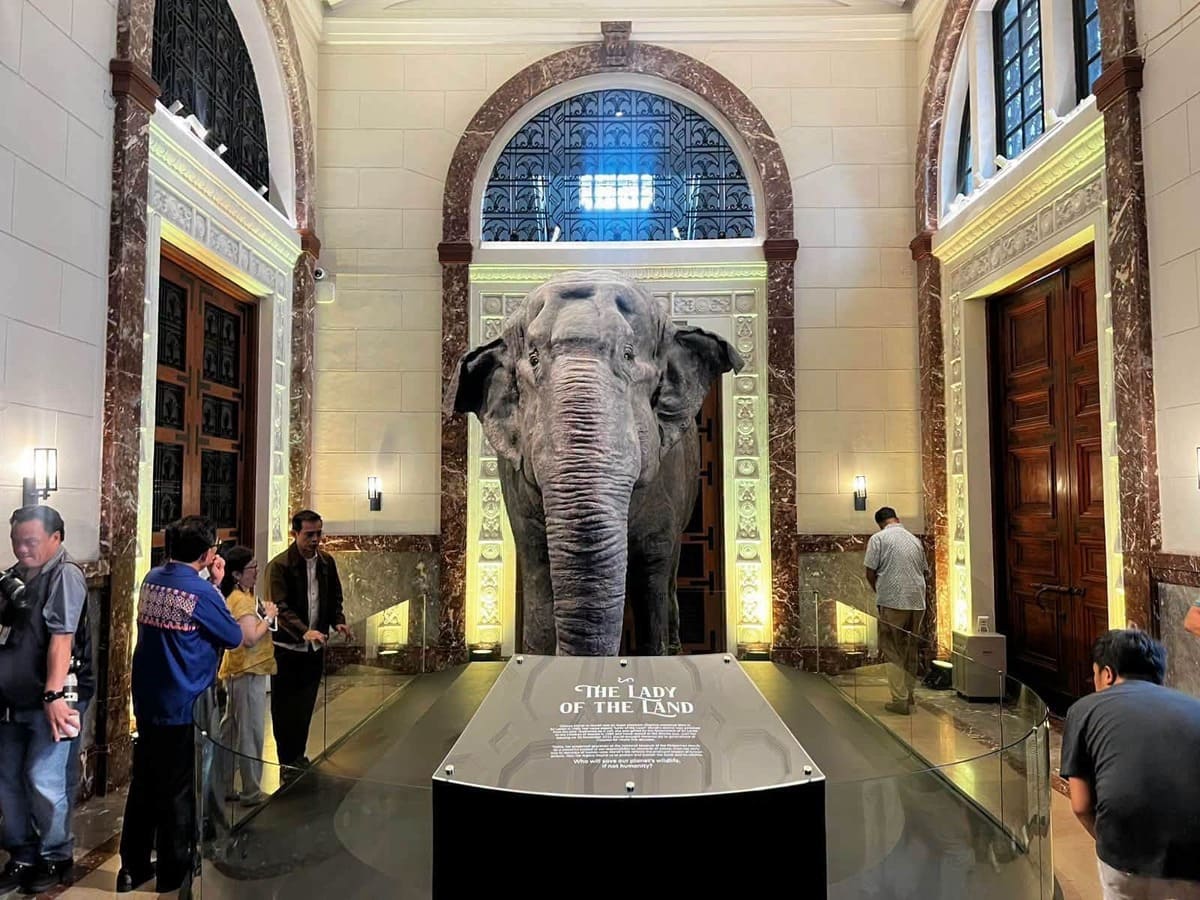
By Dwayne Doble & Photo from Department of Tourism, Culture and Arts of Manila
The public gaze is a confine where being seen is being invisible.
Majestic creatures that are supposed to belong in the wild, like Ma’ali, are still on wide display at the National Museum of Natural History, even after her death where she will always be transparent.
Offered Sole
Ma’ali, the Asian Elephant, was born in the wilds of Sri Lanka in 1974. At 11 months old, she was left by her herd and was later found and brought in by the Pinnawala Elephant Orphanage.
There she lived the first few years of her life before she was sent off to the Philippines as a gift to the former First Lady, Imelda Marcos, in 1977.
Being the country’s oldest and one of Asia’s only zoos, the Manila Zoological and Botanical Garden, or more commonly referred to as the “Manila Zoo”, was where Ma’ali was situated. However, despite being called by some as “the world’s loneliest elephant,” she was not entirely alone when she arrived.
There was a slightly senior elephant that the zoo had also taken in earlier in the year from a circus that went bankrupt. She was named Shiva and was around 10-13 years older compared to Ma’ali. Despite being highly social animals, Shiva was extremely territorial and aggressive against Ma’ali.
Their relationship had been so volatile that the zookeepers had to separate their already small enclosure, already less than a hundred square meters, into two and placed Shiva in the smaller half to prevent further injuries.
This arrangement then went on for the next 13 years before Shiva passed away in 1990, leaving Ma’ali to live the rest of her life alone.
Elephas Maximus
Elephants are known to be greatly adaptable and highly communal. In the wild, they live for around 50 to 60 and sometimes even reach up to 70 years old. In captivity, however, they only live to about 40 to 45 years due to the lack of exercise, stress, and other complications because of their enclosed habitats.
Elephants also usually herd together from 6 to even 12 individuals, with the oldest and wisest female taking the role of leader. They also graze 5 to 15 kilometers in a day, depending on the availability or scarcity of food and water, while following ancient migratory routes generations have walked.
For Ma’ali and those like her who live in enclosed spaces with the accompaniment of humans, it is an entirely different story.
She was fed by the people that tended to her with a diet of grass and fruit, a static and controlled diet that did not require much effort for her to consume, which led to her being on the chubbier side her whole life. She also walked on concrete floors that resulted in joint pain and foot problems due to the unrelenting rigidity of her habitation.
Still, she lived those 43 years of her life in great health despite being nowhere near the appropriate conditions a wild elephant should be in.
Because of her negative living conditions, this motivated the People for Ethical Treatment of Animals (PETA) to constantly gather outside the zoo to protest for her release into a nature reserve elsewhere.
Ele-Panties in Rallies
PETA usually aims to perform highly socially disruptive forms of marches that result in an equal amount of public visibility, leading to news outlets covering their antics.
One such rally PETA did was through a handful of women in bikinis holding heart-shaped placards protesting for the freedom of Ma’ali, as they say that she deserves to be in the wild and with her own herd. They also preached for the people to boycott the Manila Zoo as they are “too small” to support animals of that size and that they are “sentencing animals to a life of boredom.”
They had even managed to gather thousands of schoolchildren, along with multiple different celebrities, to support their cause to gain further traction in their efforts to “return Ma’ali where she belongs.”
Setting up mock cages was one of their ways to show just how cramped a space Ma’ali was living in, and they were constantly handing out flyers that showed the amount of sensory deprivation the zoo was putting their animals in.
This all went on for her entire 49 years of life up until she passed away from congestive heart failure and cancer on November 28, 2023.
No matter the number of demonstrations these animal rights activists had performed, their calls to put Ma’ali in a nature reserve would not have ended well had it gone through.
The elephant had already reached adulthood and would have been very difficult to transfer across countries without sustaining any injuries or possibly even risking her life. Even when the Manila Zoo had expanded her enclosure in December 2021, she would often stick to the parts of it that she knew. The stress of moving her to a whole different country could have been what ended her had it happened.
Elephants also don’t often take in grown-out outcasts into their herd. Ma’ali was found to have been orphaned as a baby by her own parade all those years ago. Her chances of being adopted by another if she were successfully put in a reserve would be close to none, which would have resulted in further isolation despite being in a proper habitat.
She was also raised in captivity. Animals that are fed by people lose their instinct to forage and gather food, look for water, and fend against predators. Ma’ali is a perfect example of this, as putting her back in the wild would mean that she would not know where to eat, graze, drink, and sleep— let alone what she can or can’t eat.
Getting to live out her entire life in a zoo was the best thing that could have happened to her after being found, or else she would have died before she could reach a year old back in Sri Lanka.
As Still As A Star
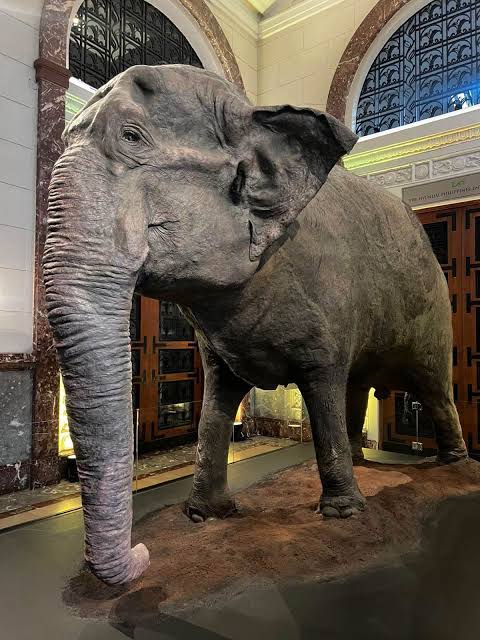
Photo from Department of Tourism, Culture and Arts of Manila
Performing taxidermy on Ma’ali may not have let her rest her body in death, but it has let her become a spectacle for the whole world to study right at the entrance of the National Museum of Natural History.
This practice lets her become a beacon of education for the youth to get a firsthand look at what Filipinos might not see in their entire lifetimes. It lets them study the anatomy of this marvel of nature in person and teaches people how different the bodies of wild and enclosed elephants look, their needs for constant movement and migratory patterns, and the psychological impact of a social animal being in a solitary space.
Her exhibit serves as a vital part of zoological education, showing the intricacies of the body of an elephant and even the large-scale techniques that it took to perform such a feat on such a huge specimen.
Most importantly, it lets the Philippines preserve her memory in the most complete form.
Ma’ali should be an example, not just for animals in captivity or in wilderness reserves, but for the whole of all life.
She was a rescue from the wild. Yes, she was not meant to be domesticated. Yes, she could have been given to an actual nature reserve in the first place instead of being a gift to former First Lady Imelda Marcos.
She was found as a baby, seen as a lonely creature, and she is viewed as the Philippines’ most beloved elephant. She was never invisible. People just never knew the entirety of her story.
Now, finally, we all get to see her through.