
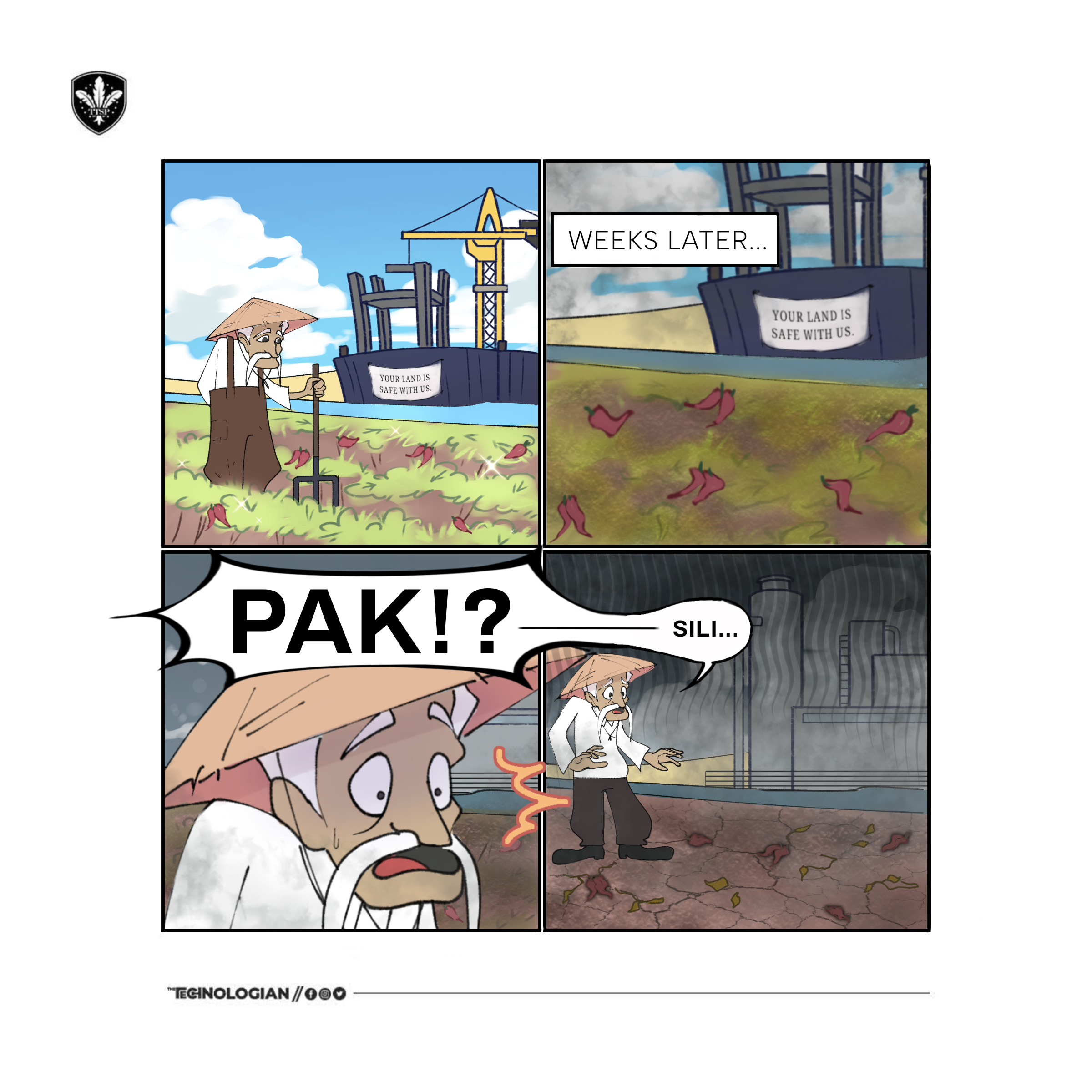
Captions by Thomas Jacob Danas & Cartoon by Stephanie Miramon
The United States-led coalition Pax Silica hides an intentional naming choice. Splitting the term into two parts, “silica” refers to silicon, one of the key minerals widely used in the hardware that powers the technological revolution across all forms of artificial intelligence (AI). On the other hand, “pax” is the more interesting word of the pair; it is the Latin word for “peace” and “stability”—more specifically, the kind of peace and stability maintained by a single dominant authority. From the name alone, the overarching goal of the coalition is laid bare: to secure the necessary raw materials, technology, and infrastructure to lead a world rapidly shaped by AI.

Photo from Dexter Barro II/MANILA BULLETIN
Last April 2026, the Philippines became the 13th country to join the Pax Silica coalition, hoping to partake in the AI-driven economy and mutual prosperity between nations. Unlike most partnering nations, the Philippines’s value in the semiconductor industry lies in chip assembly, testing, and exports. Playing into this strength, the Philippines, together with America, intends to construct an AI and semiconductor manufacturing hub in New Clark City. Led by the Bases and Conversion and Development Authority (BCDA), they have successfully secured a lease for 1,618 hectares of land to make it possible. For the Philippines, its completion could mean playing a more active role in AI, moving up the value chain in the semiconductor industry, and generating more direct jobs for Filipinos.
Indeed, Pax Silica looks lucrative on paper, promising a future where the Philippines could advance its position in an AI-driven economy. Many economists, analysts, and those at the top brass have promised economic growth from the initiative; the BCDA estimates 180 billion pesos in revenue and 200,000 direct jobs, and the Department of Information and Communications Technology (DICT) foresees a total of 180,000 to 500,000 jobs. Even President Ferdinand Marcos Jr. himself is supportive of Pax Silica, assuring that it will “bring quality jobs to the people” in his State of the Nation Address this year.
However, as the Philippines and the US run to close a developmental framework within the year, much of the appeal in Pax Silica remains founded in conjecture and confusion. Early estimates on a substantial initiative like this tend to fluctuate greatly, as these figures could mean anything between short-term construction jobs or more permanent operational jobs should it be completed. In other words, the number of jobs does not equate to job stability.
Job quality is another concern entirely. DICT claimed that the industrial hub could utilize AI hyperscale data centers with power reaching 400 megawatts, providing compute to power AI models within the Pax Silica coalition. Here, the promise of “quality jobs” becomes moot, because current data centers run automatically with little need for maintenance and upkeep, thus needing little to no human support after construction. And even when BCDA ruled out the possibility of developing AI data centers, contradicting DICT’s earlier claim, the same logic stands; the mineral production and electronics assembly expected of semiconductor hubs remains a low-tier job on the value chain.
So, in the end, local workers would once again be cheated out of maximizing their expertise, under the guise of economic growth in collaboration with America. Furthermore, without clear details on the role of the Philippines beyond production, the country would once again be stuck with only potential to elevate themselves in the supply chain, while the actual ownership of the process—such as research and development, higher-value products, and intellectual property—is outsourced to foreign companies and partnering nations.
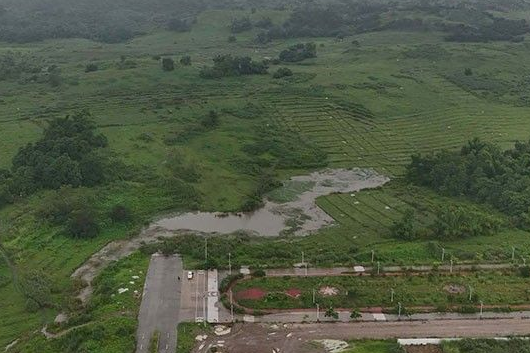
Photo from Michael Varcas / The Philippine STAR
Meanwhile, as Pax Silica’s promises and projections continue to dazzle investors, the consequences only grow ever clearer: the Pax Silica industrial hub would displace communities, especially farmers, and strip them of their land and livelihoods.
In fact, the BCDA has begun taking action to secure the hectares encompassed by the lease and the buildable land around the proposed site. Since the end of July, more than 90 farmers in Tarlac have been asked to leave their farmlands in favor of Pax Silica, leaving them scrambling towards the local government, unsure of what to do. Some farmers even said that they were offered to sell their land for measly prices in order to pave the way for the industrial hub.
Aside from farmers, local communities and indigenous peoples in the surrounding areas are already at risk. For instance, families living in Brgy. Sta. Lucia, Capas were served a one-month eviction notice last May without prior consultation by the BCDA, which stated that no one lived on the land despite the presence of a community. In fact, environmental groups estimate that 20,000 Aeta residents who have been living on or around the area for generations stand to be affected by the long-term development, and because many of the families in affected areas do not possess formal land or ancestral domain titles, they too become more susceptible to displacement. To make matters worse, the government remains mum on supporting institutions and mechanisms for Filipinos who were potentially forced out of their homes; instead, the BCDA continues to deny the idea of displacement, emphasizing their first claim on the land.
Even though the lease now is for 1,618 hectares, expansion becomes inevitable should the project progress. As an example, current plans indicate that the hub will run primarily on clean and renewable energy. While that may sound positive, the facilities needed to generate that much power would mean more space required for construction, entailing heavier trade-offs in terms of land. In turn, the Philippines loses out on arable land and places more Filipinos at risk of displacement. Additionally, as part of mineral production, other parts of the country aside from New Clark City would be cleared for mining operations, resulting in the bulldozing of more ecosystems to realize the industrial project.
This sets a dangerous precedent for the long-term development of Pax Silica. These injustices reveal the lengths the government is willing to go to make the hub a reality; they are willing to uproot locals and indigenous peoples who were on the land way before the industry. It becomes ironic then that farmers are said to be the priority of the nation’s food security, but they are the first to be sacrificed in the name of progress. Even without breaking ground on this industrial hub, Pax Silica is already harming Filipinos, and the costs that the country will shoulder because of this project outweigh the promises of economic ventures. If selling out agricultural workers, local communities, and swaths of land is only a step towards realizing the goals of Pax Silica, imagine how much more would be sacrificed once the industrial hub becomes fully operational.
Most pro-Pax Silica supporters deem these kinds of sacrifices necessary for progress, in favor of the potential economic boom it could provide for the Philippines. To them, the reward is worth the risk, even when the rewards could potentially be formed from delusions along the way. But even considering the land, people, and resources at risk from the initial lease alone is more than enough to show that it is not worth it at all. Beneath the development plans and negotiation tables, will these Filipinos, who had or will have their lives and livelihoods ripped away from them, benefit from these projects as much as investors do?
Some are quick to jump to the conclusion that denying Pax Silica is denying progress for the country, but that is untrue. Many doubts surround the project in terms of planned development, and the forced removal of local communities even before the supposed finalized deal only raises more questions than answers. If “progress” calls for destroying Filipino lives and resources—without due support and compensation—over shallow promises of prosperity and uncertain futures for the displaced, can it really be called progress? It sounds more like the country is intentionally bleeding itself out for nothing in return.
Simply put, true progress for the nation should not come at the cost of any life, especially for farmers, indigenous peoples, and ordinary Filipinos. It should not be rooted in the destruction of homes and resources, especially for causes where the Philippines stands to gain very little benefit. Resistance against Pax Silica does not automatically mean opposition against any form of progress; instead, it signals that Filipinos know that this form of “progress” does not achieve the outcomes of “peace” and “stability” desired by the coalition. After all, “peace” and “stability” for the country do not come from evicting other people or the mechanical hum of yet another industrial hub.
At the very least, the government should postpone the closure of the deal between the US and the Philippines to comprehensively examine the long-term implications of Pax Silica on the resources and environment of the country. They must cease the forceful eviction of local communities on the proposed project site and provide reparations for those who are affected. Clear-cut evidence and faultless transparency regarding the coalition and the development should replace speculation, glamor, and hollow promises.
Ultimately, however, if they wish to achieve true progress, they must direct their overenthusiasm for this coalition towards funding homegrown industries and empowering the Filipino people with the assets and support to enact impactful positive change across the nation. And most importantly, Filipino people and resources should be treated with respect and dignity, not freely given away or sacrificed to the whims of an uncertain future.
All lives are not mere transactions on the negotiating table; they are the heart of the economy itself. From the very beginning, Pax Silica’s violation of that sanctity should have been the dealbreaker.